
LATHE The lathe is a machine tool used principally for shaping pieces of metal (and sometimes wood or other materials) by causing the workpiece to be held and rotated by the lathe while a tool bit is advanced into the work causing the cutting action. The basic lathe that. Mar 24, 2017 Work Held Between Centre 10. Work Held Between Centres 11. Face plate. A faceplate is the basic workholding accessory for a lathe. It is a circular metal plate which fixes to the end of the lathe spindle. This course introduces the fundamentals of machine tool and computer tool use. Students work with a variety of machine tools including the bandsaw, milling machine, and lathe. Instruction given on MATLAB®, MAPLE®, XESS™, and CAD. Emphasis is on problem solving, not programming or algorithmic development. Assignments are project-oriented relating to mechanical engineering. After centering the work the fixed steady is positioned, and pads are adjusted to hold the cat head’s centre portion. When the lathe is running the work revolves along with the ends of the cat head whereas the centre portion is stationary. Another type of cat head, shown, is a.
- Lathe: Work Centering The Mechanic Position
- Lathe: Work Centering The Mechanic Software
- Lathe: Work Centering The Mechanical
| ||||
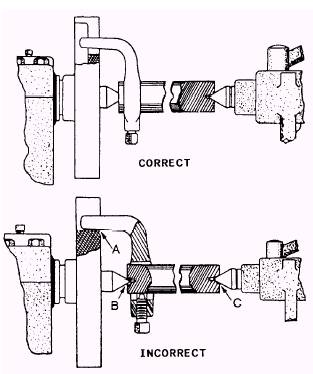
| Holding Work Between Centers To machine a workpiece between centers, drill center holes in each end to receive the lathe centers. Secure a lathe dog to the workpiece. Then mount the work between the live and dead centers of the lathe. CENTERING THE WORK.—To center round stock where the ends are to be turned and must be concentric with the unturned body, mount the work on the head spindle in a universal chuck or a draw-in collet chuck If the work is long and too large to pass through the spindle, use a center rest to support one end. Mount a center drill in a drill chuck in the tailstock spindle and feed it to the work by turning the tailstock handwheel (fig. 9-21). For center drilling a workpiece, the combined drill and countersink is the most practical tool. These combined drills and countersinks vary in size and the drill points also vary. Sometimes a drill point on one end will be 1/8 inch in diameter, and the drill point on the opposite end will be 3/16 inch in diameter. The angle of the center drill must always be 60° so that the countersunk hole will fit the angle of the lathe center point. If a center drill is not available, center the work with a small twist drill. Let the drill enter the work a sufficient distance on each end; then follow with a 60° countersink. In center drilling, use a drop or two of oil on the drill. Feed the drill slowly and carefully to prevent breaking the tip. Take extreme care when the work is heavy, because you will be less able to “feel” the proper feed of the work on the center drill. If the center drill breaks during countersinking and part of the broken drill remains in the work, you must remove this part. Sometimes you can drive the broken piece out by a chisel or by jarring it loose, but it may stick so hard that you cannot remove it this way. Then you must anneal the broken part of the drill and drill it out. We cannot overemphasize the importance of proper center holes in the work and a correct angle on the point of the lathe centers. To do an accurate job between centers on the lathe, you must ensure that the center-drilled holes are the proper size and depth and that the points of the lathe centers are true and accurate. Figure 9-22.—Examples of work mounted between centers. MOUNTING THE WORK.—Figure 9-22 shows correct and incorrect ways to mount work between centers. In the correct example, the driving dog is attached to the work and held rigidly by the setscrew. The tail of the dog rests in the slot of the faceplate, without touching the bottom of the slot. The tail extends beyond the base of the slot so that the work rests firmly on both the headstock center and the tailstock center. In the incorrect example, note that the tail of the dog rests on the bottom of the slot on the faceplate at A and pulls the work away from the center’s point, as shown at B and C. This causes the work to revolve eccentrically. In mounting work between centers for machining, be sure there is no end play between the work and the dead center. However, do not have the work held too tightly by the tailstock center. If you do, as the work revolves, it will heat the center’s point, destroying both itself and the center. To help prevent overheating, lubricate the tailstock center with grease or oil. Holding Work on a Mandrel Many parts, such as bushings, gears, collars, and pulleys, require all the finished external surfaces to run true with their center hole, or bore. General practice is to finish the bore to a standard size within the limit of the accuracy desired. Thus a 3/4-inch standard bore would have a finished diameter of from 0.7495 to 0.7505 inch This variation is due to a tolerance of 0.0005 inch below and above the true standard of exactly 0.750 inch. First drill the hole to within a few thousandths of an inch of the finished size; then remove the remainder of the material with a machine reamer, following with a hand reamer if the limits are extremely close. Then press the piece on a mandrel tightly enough so the work will not slip while being machined Clamp a dog on the mandrel, which is mounted between centers. Since the mandrel surface runs true with respect to the lathe axis, the turned surfaces of the work on the mandrel will be true with respect to the bore of the piece. A mandrel is simply a round piece of steel of convenient length which has been center drilled and ground true with the center holes. Commercial mandrels are made of tool steel, hardened and ground with a slight taper (usually 0.0005 inch per inch). This taper allows the standard hole in the work to vary according to the usual shop practice and still provides a drive to the work when the mandrel is pressed into the hole. The taper is not great enough to distort the hole in the work The center-drilled centers of the mandrel are lapped for accuracy. The ends are turned smaller than the body of the mandrel and provided with flats, which give a driving surface for the lathe dog. | ||||
Privacy Statement - Copyright Information. - Contact Us
At Dan's Machine Tool, Inc., we specialize in the repair and reconditioning of all types of metalworking equipment. Customers trust us to provide the critical repairs to their mills, lathes, iron workers, benders, and other machinery that keep production running. When a piece of equipment is down or not functioning properly, an experienced technician can make a visit to the customer’s facility in order to make an initial diagnosis. Depending on the severity of the issue, a repair may be made on-site or the equipment can be transferred to our facility.
For full rebuilds, equipment is cleaned, disassembled, and all components are evaluated for wear. Any belts, bushings, fasteners, and other wear parts are replaced as needed and structural repairs are completed to the frame and body. Ways can be ground parallel and hand scraped to factory tolerances. The machine can then be reassembled and tested to customer requirements. We can also repair and rebuild older equipment that most shops no longer support, including Bridgeport mills. Through our extensive used equipment network, we maintain a significant inventory of hard to find replacement parts salvaged from older machinery. For more information about our equipment repair and rebuilding capability, see the table below, or contact us directly.
Photo Gallery of Before & After Repairs & Rebuilds
LeBlond Lathe Rebuild
(click on thumbnail to enlarge)
Lathe: Work Centering The Mechanic Position
Mori Seiki Lathe Repair & Rebuild
(click on thumbnail to enlarge)
Bridgeport Milling Machine Repair & Rebuild


(click on thumbnail to enlarge)
Project Showcase of Metalworking Equipment Repair & Rebuilds
Machines & Brands We Repair
- Milling Machines
- Acra
Bridgeport
Cincinnati
Clark - Kent
Jet
Lagun
All import milling machines
- Acra
- Lathes
- Acra
Clark
Cadillac
Hardinge - Kent
Mori Seiki
LeBlond
Webb
All imported lathes
- Acra
- Surface Grinders
- Boyar Schultz
Harig
Kent - Mitsui
All imports
- Boyar Schultz
Metalworking Equipment Repair & Rebuilding Capabilities
- Capabilities
- Repair
Rebuilding - Maintenance Agreements
Replacement Part Supply
- Repair
- Equipment Types Available
- Mills
Lathes
Grinders
Saws
Shears - Iron Workers
Benders
Rolling Equipment
Routers
Presses
- Mills
- Repair & Rebuilding Processes
- Complete Rebuild
Head Repair
Spindle Rebuilding - Scraping of Ways
Table Resurfacing
- Complete Rebuild
- Brands
- JET Machinery
Acra
Scotchman - Ercolina
Chevalier
Majestic
- JET Machinery
- Automation
- Manual
CNC
- Additional Services
- Repair
Replacement Parts
Used Equipment Purchasing
- Lead Time
- Quoted on a Job by Job Basis
- Industries Served
- Metalworking
Manufacturing
Fabrication Shops
Dan’s Machine Tool, Inc. offers Preventative Maintenance and Diagnostic Inspection for CNC and Manual Machinery:
MILLING MACHINES, GRINDERS, LATHES, BANDSAWS, DRILL PRESSES, PUNCH PRESSES, SHEAR AND BRAKES, ETC.
Our Preventative Maintenance can be performed Economically to Prevent equipment Breakdowns before they occur and notify you of potential Safety Issues!
The Maintenance and Diagnostic Inspection consist of multiple key steps that help prevent premature wear to vital components on your machinery. Our Diagnostic Inspection lets you know if your machinery is operating to Factory Tolerances and its full potential.
Our Preventative Maintenance and Diagnostic Inspection consist of:
Testing Axes, Spindles, Chucks, Tailstock, Leadscrews, Ball Screws and Bed Ways for excessive run out and backlash.
Ensure lubrication and hydraulic systems are dispensing properly. Draining and refilling lubrication and hydraulic reservoirs with new Grease, Way Lube and or Hydraulic Fluids. Also check the old lubrications for contaminants!
Run machinery to ensure all feeds, gears, motors and spindles etc. are operating freely and properly.
Check all electrical components, machinery conduit, on off switches, emergency switches and electrical cabinets to ensure operators safety!
During maintenance our mechanics will adjust gibs, lubrication fittings, handles, loose conduit and electrical connections. Also removing debris, excess grease and lubrication from the body and operating areas of the machinery.
Providing a complete diagnostic report to your company detailing findings.
PURCHASE ORDER REQUIRED, PLEASE CALL TO SCHEDULE
Lathe: Work Centering The Mechanic Software

Lathe: Work Centering The Mechanical
OUR TERMS: NET ON COMPLETION